
Inside Panola Property Tax Records
A Panola County tax record is really several records working together. The Tax Assessor discovers, lists, and values land and buildings. The office maintains the roll and processes homestead claims. It also keeps the ownership maps. The Tax Collector writes the bills and collects ad valorem tax. The same office manages delinquent accounts, sales, and redemption. A deed or plat can help you find the right parcel. Neither one replaces the current assessment and collection records. Those carry the numbers that actually matter.
| Tax record field | Meaning | Official source |
|---|---|---|
| True value | The assessor's full-value basis before the class ratio | Tax Assessor |
| Assessed value | True value multiplied by the state assessment ratio | Tax roll and MFC layer |
| Homestead status | Whether qualifying owner-occupied relief was processed | Tax Assessor |
| Bill and payment status | Tax charged, paid, delinquent, or in collection | Tax Collector |
| Redemption record | Post-sale amount and steps for eligible redemption | Tax Collector and Chancery Clerk |
The official tax-search landing shows the available search modes.
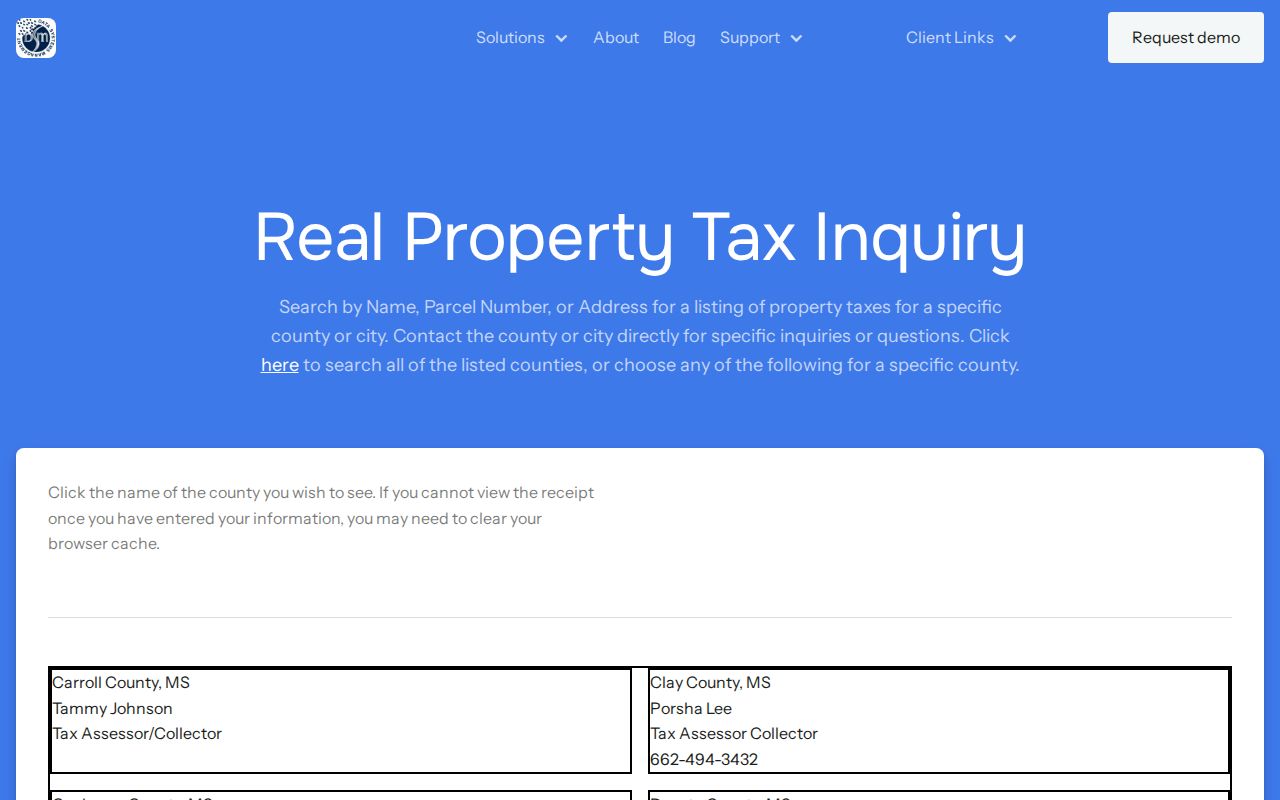
The online inquiry landing page offers entry by name, parcel number, or address. Panola's result fields stay behind the application until a search completes.
A bill is not a sale-price report. It applies local millage to assessed value, with exemptions where allowed. Whenever you compare two Panola County records, confirm the tax year first. Assessment, deed, and GIS sources update on different schedules.
Panola Tax Search Routes
The official Mississippi-linked property-tax inquiry lists three search modes: Name, Parcel Number, and Address. The Panola version runs as a JavaScript application. Those advertised modes are dependable entry points for a property search. Still, do not assume coverage years, fees, or result details. The application does not plainly display them.
| Search key | Best use | Important limit |
|---|---|---|
| Name | Find accounts tied to a known owner spelling | Names may vary or the roll may lag a deed |
| Parcel number | Match the same tax unit across systems | Copy it exactly; no universal Panola format was verified |
| Address | Begin with a known site location | Mailing and physical addresses may differ |
When the application will not load, the MFC Panola parcel layer is a solid fallback. Pull the parcel number, physical address, and legal description from that GIS map. Then call the assessor or collector and name the tax year you want. This route works especially well for rural legal descriptions. Those descriptions never match a simple street search.
Panola's Tax Formula
Mississippi's Department of Revenue lays out the formula plainly. True value is multiplied by the assessment ratio, then by millage. Class I owner-occupied single-family real property carries a 10 percent ratio. Class II, covering other real property, uses 15 percent. One mill equals one-thousandth of assessed value. Local authorities set the millage, so a class ratio is not the local tax rate and should never be confused with one.
- True value
- The assessor's estimate before a class ratio is applied.
- Assessed value
- The taxable value produced by applying the state ratio.
- Millage
- The local levy applied to assessed value; one mill is 0.001.
- Homestead exemption
- Relief for a qualifying primary residence.
- Tax lien
- A public claim linked to unpaid property tax; its current status requires official confirmation.
The public MFC layer shows assessment pieces for cultivated land, uncultivated land, improvements, and total assessed value. Those map fields help with comparison work. They are not a live tax bill, though, and their update date can lag behind the collector's account.
Look Up Panola Property Tax
Keep the account, year, and source attached to every number you record. A single screen is never the whole story. Follow Panola County property tax records from the search result back to the office record before drawing conclusions.
- Search the state-linked inquiry by address. If it fails, repeat with the exact parcel number obtained from GIS.
- Record the tax year, true value, assessed amount, exemption notation, bill amount, and payment status that the official record supplies.
- Compare the parcel and legal-description keys with the deed or GIS entry. Resolve mismatches with the assessor before relying on the amount.
- Ask the Tax Collector whether a delinquent entry has been paid, sold, redeemed, postponed, or otherwise changed.
Online access is only one channel. The Panola County Tax Assessor page offers the office route. It covers ownership maps, values, homestead, and tax questions. In-person, telephone, mail, and Mississippi Public Records Act requests all remain open. Use those when the application will not show the year or field you need. Older tax material can also sit with the Chancery offices or MDAH collections.
Panola Homestead Timing
Homestead applications run from January 1 through April 1. The applicant must own and occupy the primary residence on January 1. A change in ownership, marital status, use, or occupancy can require a new filing. Mississippi DOR also describes special elderly and disabled treatment. It includes a $75,000 true-value amount for eligible applicants.
Do not read eligibility into a blank online field. The county publishes no field-by-field exemption card. Take proof of ownership and occupancy to the assessor. Ask which documents apply. Keep the filed receipt or written office response with the tax-year record.
Four-Year Panola Revaluation
Mississippi requires real property to be revalued at least once every four years. That cycle stands apart from annual tax administration. It also differs from another lag. A newly recorded deed does not appear instantly in an online display. Panola publishes no fixed deed-to-roll refresh schedule.
A changed assessment can reflect revaluation, new improvements, corrected acreage, classification, or another roll update. Compare notices from the same year and ask the assessor what changed. A missing same-day web update does not cancel a recorded transfer. It also does not prove the older value still controls.
Panola Tax Sales and Redemption
Billing, delinquency, sale, and redemption are separate stages. The collector runs the annual tax-sale process for unpaid real-estate taxes and special assessments. DOR guidance mentions possible sale dates on the first Monday in April and the last Monday in August. But the current Panola notice controls. Check any delinquent line against later payment and sale records.
After a sale, the state-linked land-redemption inquiry and the Chancery Clerk can help. Ask for the parcel, tax year, and sale date. Also request the purchaser or certificate reference. Get the redemption amount and status as of a stated date. A tax sale does not by itself guarantee clear title. Litigation, bankruptcy, payment, or redemption can still change the record.
Appeal a Panola Assessment
Begin at the assessor's office. Identify the parcel and the tax year. Identify the disputed value and why you think the appraisal is off. Solid evidence makes the strongest case. So gather what you can: a recent survey, photographs showing condition, comparable sales, an independent appraisal, corrected property characteristics, and the latest deed recorded for the parcel. Keep two questions apart, though. The valuation dispute is one matter; a disagreement over the tax bill itself is another.
Confirm the current appeal date. A valuation challenge normally begins through the county Board of Supervisors schedule described by DOR. The state Board of Tax Appeals route generally requires a written request within twenty days from the assessment date. Use the deadline printed on the notice because the facts and calendar can vary.
Mississippi's Department of Revenue lays out the state-level path on its official appeal page. File through the named office and keep proof of delivery, because a missed deadline can push your review to a later cycle.
Historic Panola Tax Evidence
Today's property tax records only reach back so far. For deeper Panola County history, the Mississippi Department of Archives and History offers finding aids covering county records from 1836 through 1975. Those aids identify an 1857 assessment roll, selected tax-sale copies from 1858 to 1859, collector material, deeds, and related land records. Originals are consulted in the Reading Room. Microfilm is available in the Media Room. That archive route can confirm an older tax or land clue, yet it will not tell you the amount due on a current account. When requesting material, cite the box, item, and year. From there, reconnect the historical description to a modern parcel through its legal description, deed reference, and current tax account.
Panola Tax Office Channels
Panola County runs courthouse operations in both Batesville and Sardis. A simple "visit the courthouse" therefore leaves too much unsaid. Address your request to the Tax Assessor or the Tax Collector by name. Include the parcel number and tax year. Ask which location holds the roll, bill, redemption entry, or supporting document you need. For current contact details, the county assessor page is the most reliable source. The documented Sardis assessor and collector number is 662-487-2092. A counter visit or phone call may fail to produce a public record. A written request under the Mississippi Public Records Act of 1983 is the next step. Describe the record precisely rather than asking staff to research open-endedly. Include the owner of record's spelling if known. Add the site address, the parcel identifier, the tax year, and the exact fields or copies you want. Ask about costs in advance, since Panola County publishes no general tax-copy fee. Older tax questions may reach past the current offices. MDAH's Panola finding aid covers county material from 1836 through 1975. Those archival records support property history research. They cannot state what is due on a current account.